David Mills, the founder of The British Wildlife Centre, speaks to us on mistaking sheep for polar bears, giving up on dairy farming, and the wise words of Dolly Parton.
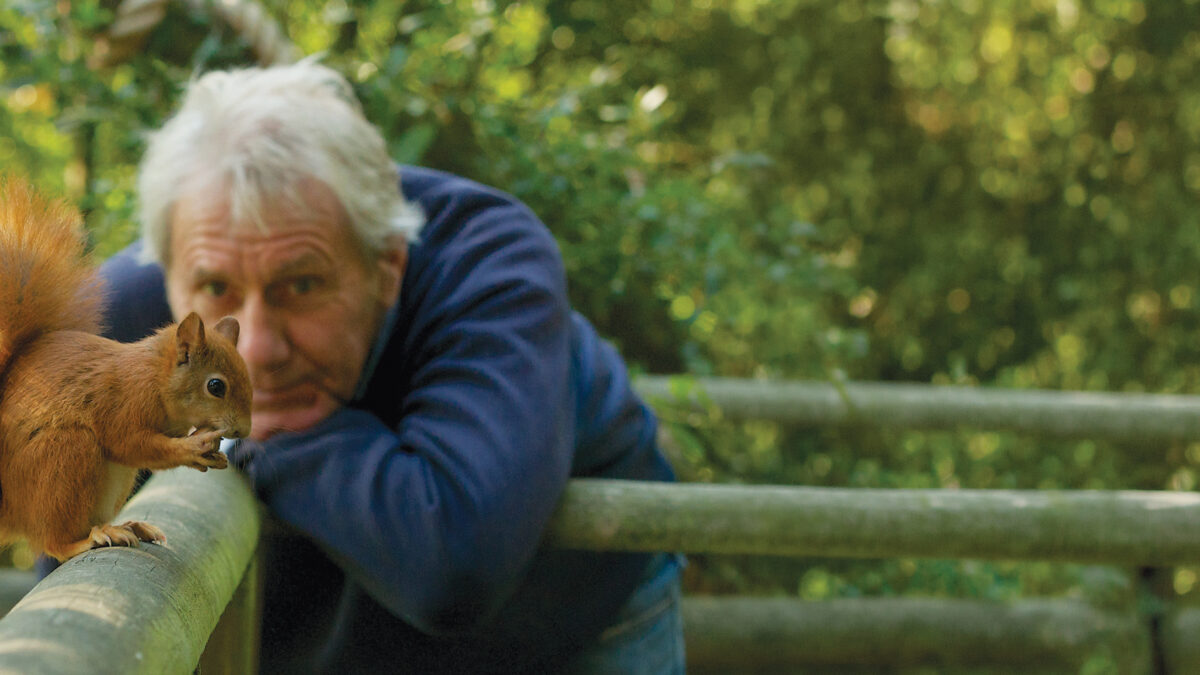
There are two loves in David Mills’ life. The first – the humble jersey cow, a herd of which he auctioned to establish what is now The British Wildlife Centre. The second (and arguably, by extension, the third) – the red squirrel. In 2010, he built a walk-through red squirrel enclosure, the ‘first of its kind’ in the country. Judi Dench, a fellow nature-lover, cut the ribbon. Now in the sixteenth year of their relationship – Dench calls him ‘her chap’ – he is still remarkably cognizant of the role animals have played in shaping the world in which he lives – ‘the Jersey cow gave me this,’ he says, flamboyantly gesturing to the rather cluttered office in which we sit, ‘and the red squirrel gave me Jude’.
I have been welcomed to The British Wildlife Centre on one of the hottest days of the year. And yet, and is naturally the case when animals are involved, business continues as usual. Mills’ team are unruffled by the stifling heat – they sit at desks piled with an allsorts selection of wildlife books, maps, and brochures. They’re giggling about the office ‘newbie’, who is celebrating ten years at the centre. Matt, the Head Keeper, has worked there for twenty-two. He comes in briefly, to test the air, and disappears soon afterward – presumably to attend to his expansive flock.
There’s a comfortable – and not to use the word lightly – familial atmosphere in the centre. Mills has created a space where people love to come – not least the employees, but also the hoards of visitors that have arrived this morning. When I enter the gates, I’m confronted by a toddler, his face pressed against a glass tank that appears to contain several tiny harvest mice. He is enthralled in observing life even smaller than himself.
Mills began his career as a dairy farmer, with an award-winning herd, living on the grounds that would later become the centre. There’s a grainy image of him in one of the displays dotted around the site, grinning a little mawkishly as he braces his body against the deep russet hide that is unique to Jersey cows. Another lifetime. Yet, much of the centre’s farming past remain – holding pens have been repurposed into visitor areas. A barn into a coffee shop. Same principles, different species.
‘‘I got to the age of 50, and said that by 55, I don’t want to be milking cows’’. And so, he founded the centre in 1997, making the decision to specialise entirely in wildlife native to the UK.
The centre is, at the time of interview, grappling with the lengthy (and form-heavy) task of becoming a charity. Mills is focused by the risk of it becoming a very different kind of visitor experience, if not successful. ‘‘If it was sold, it could be turned into anything. It could become a theme park. It could become a big zoo that’s opened every day of the year. In order to try and safeguard what we’ve got here, the only way is to turn it into a charity.’’ He seems painfully aware of the time he has left, and at several points, refers to the idea of ‘legacy’. ‘‘You never know how fast things might change. You need to get all of your ducks in a row.’’
There’s an apparent lack of any of the qualities one would normally associate with a ‘zoo’ – which, despite its name, is what the centre technically functions as. There are no ‘exotic’ animals for a start. No blaring music designed to conjure imagined states of the Orient. No burger shacks, rollercoaster rides, or giant multi-coloured plastic bins which open like the slack, unhinging jaw of a crocodile. There’re a few wooden picnic tables which house hungry families. Fields of wildflowers, portioned by fencing, which badgers have determinedly burrowed through. A small coffee shop staffed by another member of his long-serving team. ‘‘There’s something Dolly Parton once said, which comes to mind.’’ Mills says. ‘‘It takes a lot of you know, to look like this’’. The British Wildlife Centre has not, however, been designed for spectacle. It first and foremost is a home for the species that, many of which, have chosen to live within. Otters bask in a glassy pond. A fox pads across a lawn of its enclosure. Near to Mills’ home, which straddles the grounds, I see a red squirrel napping on the pedestal of a stump.
There’s a clear purpose this serves, which is beyond the folksy, Blyton-esque vision that is immediately apparent. Mills tells me stories about schoolchildren who thought a field of sheep was a terrifying army of polar bears. Or keepers painstakingly explaining that milk isn’t made in the supermarket. ‘‘What we try to do is to educate people, and I think we’re winning slowly.’’
As we conclude the interview, the midday sun reaching its peak over a dense thicket of woodland on the horizon, he tells me he is sometimes ‘frightened’ of the way the world is turning – the growing psychological influence of technology, the traditions being replaced by the monotone of efficiency. ”There’s something reassuring about this”, he says, motioning to the idyll around us. A plane noisily passes overhead. ”Or close to it”.
‘‘What we try to do is to educate people, and I think we’re winning slowly.’’