As she begins her retirement, Dr Cathy Gleeson reflects on three decades of work in palliative care at St Catherine’s Hospice- and a lifelong dedication to giving ‘the gift of time’.
There is a distinct clue as to the kind of connection Dr Cathy Gleeson has fostered over the last three decades, that is built into the very name badge she wore to work. ‘‘My name is Catherine, but I prefer to be called Cathy by my friends and family, and when I became ‘Cathy’ on my work email address, it made sense that patients and their visitors called me Cathy too.’’’
And so, Cathy it was. Cathy’s journey to palliative care, however, starts long before – as a young girl playing dress-up with her sisters, persuading the youngest to be the patient, and bandaging felt-tip drawn injuries. A family friend visited when she was six, asking her what she wanted to be when she grew up. ‘‘I’m going to be a doctor”, Cathy said. He replied: “Don’t you mean a nurse?” ‘‘No,’’ she said. “I’m going to be a doctor.”
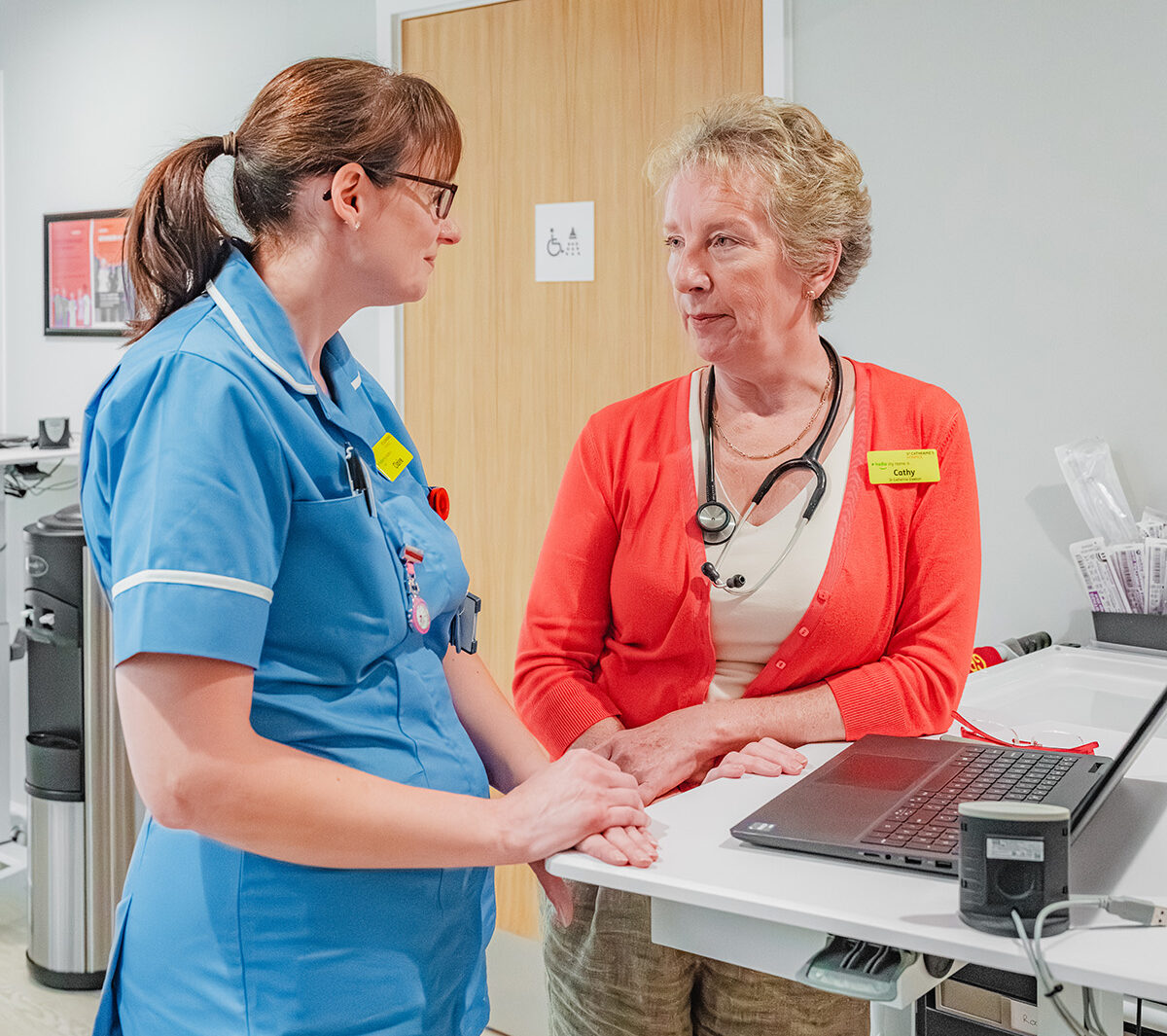
Sticking to her guns, Cathy trained as a GP, deciding to work at the local hospice as a means to gain a broader experience of doctoring. She came to the original St Catherine’s site in Crawley, and upon walking in, noticed the ‘light, airy space, how friendly everyone was…and, of course, the laughter’ – which she acknowledged surprised her – a far cry from the spaces that likely occupy the public imagination.
Cathy set up the first registrar post at the Hospice, harking in a new era of palliative care – which, at that time, was undeniably ‘on the periphery of healthcare’ – viewed perhaps more as a pastoral service, than a serious medical pathway. Much has changed since those first formative years – the Hospice, sustained by nurses, consultants, and volunteers, has expanded (and occasionally contracted), both nurtured and made vulnerable by the presence of funding, and by its absence.
Cathy alongside the Hospice team, was challenged to work with the evolving definitions of palliative care. In the onset of COVID, Cathy continued educating on the multi-faceted aspects of sickness – the idea that patients often experience multiple diseases and disorders, requiring treatment to keep pace with an increasingly complex medical narrative. And at a time when the pandemic had reached its most devastating peak, Cathy and her peers were working on a plan – which, while negotiating workers not only through the most significant health crisis in the last century, aimed to educate them on the ways to grapple with a fast developing patient base.
‘When I first started out, no-one knew what palliative care was’.
It was at this time, Cathy recognised a cultural shift – not only in the way in which
the public spoke about death, and dying – but in how it was registered, and understood. ‘When I first started out, no-one knew what palliative care was. People were very frightened about the word hospice, and you weren’t allowed to say where you were from. COVID shifted things. It highlighted how important professional help and support was when someone is dying – it made us all think a little bit more about our own lives; our own deaths, and the importance of contact with those we love.’’
Cathy, partly due to her lived experience, but perhaps more a reflection of her fundamental outlook and character, is deeply conscious of the surprising tensions that exist between living and dying – and the complex feelings that are found in between. ‘‘I think the most important gift is time. Time and listening. And that’s run through the core of what I do. I wanted to try to help people understand what’s happening so that they can make sense of it.’’
One of Cathy’s first patients perhaps encapsulates this ethos best. ‘‘He couldn’t swallow properly, and he couldn’t talk properly. He had tubes in his neck and his tummy, and was in a miserable state. I got to know him over several weeks. One day, I asked him – ‘what would help?’ He told me: ‘I just want to go home’’. In a matter of weeks, Cathy and the team had trained the patient to manage his tubes, allowing him to do what he had most wanted to do. When he returned, she saw him smile for the very first time.
Cathy is at her most reticent when acknowledging her own achievements. She emphasises – repeatedly – the significance of the team around her at St Catherine’s, the joy she has felt in being a part of their journey, her love of being an educator and mentor. The often-unnoticed efforts of the volunteers – who support not only with their time, and commitment – but their ‘kindness’. Cathy’s co-workers, however, are more than willing to highlight the ‘significant void’ left in her retirement. ‘The ward is often referred to as ‘Cathy’s In-Patient-Unit’,’’ one tells me. ‘‘She is leaving behind a legacy we are proud to carry.’’
And what does Cathy herself feel as she leaves this legacy behind?
‘‘It has been a privilege. I feel so fortunate to have had the career I’ve had.’’
She shifts a little in her chair when I ask if she is proud, pausing to locate a word that sits just out of reach. ‘I’m not sure if it’s pride. I feel complete.’’